
Why baby's breath is everywhere right now
Baby's breath has shed its filler flower past completely. Walk through any UK wedding venue, scroll through any minimalist interiors account or look at any newborn photoshoot from the last three years and gypsophila is pretty much present. I mean we're not complaining, gypsophily is a dream flower here at FLOWERFIX.
Below are fifteen styling ideas that show off what baby's breath can do at weddings, in homes, on tables, in installations, and as dried displays that last for over a year. Each section covers what the look needs, how much gypsophila to budget for and where to source it.
A quick note on the FlowerFix range: we offer baby's breath in classic white and our signature ombré coloured collection such as pink gypsophila. Both work for almost every idea below. The colour decision is mostly about the aesthetic of the space and the personality of the recipient. We often find customers opt for pink baby's breath for girl gender reveals.
1. The standalone vase: the most underrated gypsophila styling
The simplest idea is also one of the most striking. A clear glass vase, five to seven stems of pure white gypsophila, nothing else. The cloud effect is dramatic and all that is needed.
What it needs: A wide-mouthed vase rather than a narrow one. Gypsophila branches outward, and a narrow vase forces it into a tight, mushroom like shape.
Volume guide: Five stems for a medium vase. Ten plus stems for a generous, full display.
Pro tip: Fill the vase with only an inch or two of water, gypsophila prefers shallow water and wilts faster in deep vases.
Shop fresh white baby's breath
2. The ombré statement piece
Our signature ombré gypsophila takes the standalone vase idea and adds colours to your space. The graduated colours in pastel and rainbow blends create a single arrangement that becomes the focal point of any room.
What it needs: A neutral surrounding. Ombré gypsophila does not want to compete with patterned wallpaper or busy textiles. A clean wall behind it lets the colours do the work.
Where it lands well: Console tables in entrance halls, dining tables for casual hosting or a kitchen island where the colour can be properly seen.
3. The bridal bouquet: pure white, pure classy
Pure white baby's breath bridal bouquets have become one of the most popular wedding choices in the UK. A loose, hand-tied bouquet of gypsophila alone is romantic, photographs beautifully against any dress colour, and costs significantly less than equivalent volumes of roses or peonies.
What it needs: Two to three full bunches (around 15-20 stems) for a generous hand-tied bouquet. A single tight bunch is too sparse for a bridal moment.
Styling note: Wrap the stems in a soft satin or silk ribbon in the bride's accent colour. White ribbon for an entirely monochromatic look.
Why brides love it: Lightweight to carry through a long ceremony, drops no petals on the dress, and dries naturally afterwards into a permanent keepsake.
4. The mixed bridal bouquet: gypsophila as the supporting act
If pure gypsophila feels too boring, baby's breath as a complementary flower around hero stems creates one of the most romantic wedding aesthetics available. Pink garden roses with white gypsophila is a traditional combination for a reason.
Best pairings: Garden roses, lisianthus, ranunculus, peonies (in season), and tulips.
Volume guide: One to two stems of gypsophila per 5 main stems is the rough ratio for a balanced look.
5. Buttonholes, hair pieces, and corsages
Tiny clusters of gypsophila are the foundation of most modern wedding buttonholes. The flowers are sturdy enough to survive being pinned, the visual texture works on any lapel colour and a single stem provides enough material for several buttonholes.
What it needs: Strip a small cluster of flowers from a main stem, wrap the base in floral tape and attach to a buttonhole pin. Optionally add one accent flower (like a small rose, freesia, or lavender sprig) for colour.
For hair pieces: Twist small stems into a halo or scatter them through a loose braid. Gypsophila works particularly well in undone in hairstyles.
6. Ceremony arches and flower walls

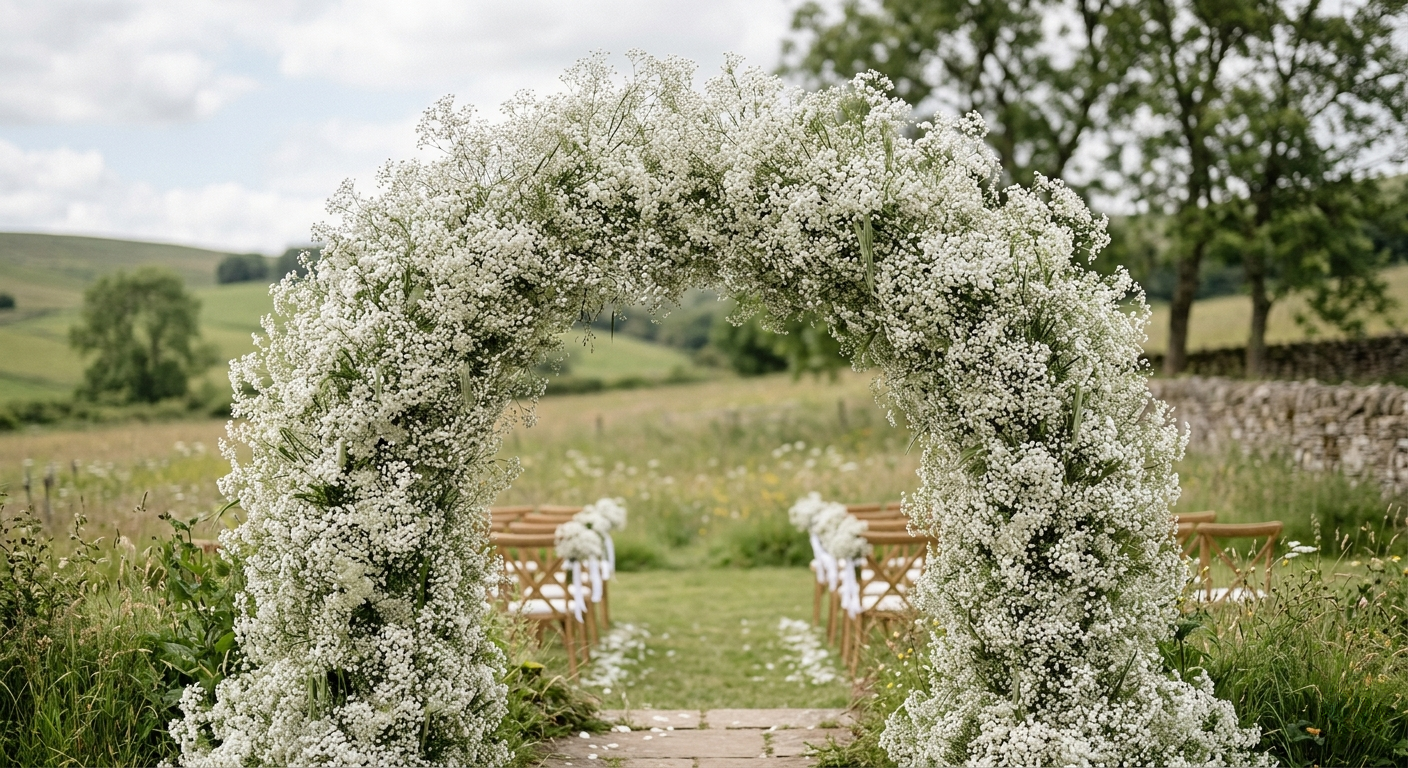
This is where baby's breath stops being subtle. A full gypsophila arch is something straight out of heaven or an instagram post at least. You'll need two wooden or metal bases. Create an arch using chicken wire to connect the two bases. Fill the chicken wire with gypsophila. Tip: if you're look is fresh fluffy gypso arch, do this the day before on the day. For a dried gyp arch, a few days, before will be enough to keep the flower with volume. It is one of the most photographed wedding installations in the UK.
What it needs: A lot of gypsophila. Depending on the arch size and how full you want this to look. We recently did a 5 metre arch where the client wanted it to be thick like a cloud. This took over 400 stems of gypsophila.
7. Long table runners and centrepieces
Trailing baby's breath down the centre of a long dining table is a beautiful look and one of the more cost-effective ways to make a wedding reception look magical. Gypsophila's natural branching shape means stems lay flat and overlap into a continuous cloud.
Volume guide: Two to three stems per linear metre of table for sparse look. For a heavy cloud appearance you're looking at closer to 10 stems per linear metre.
For mason jar centrepieces: Six to eight stems per wide-mouth jar creates a full, slightly wild look. Add a few sprigs of eucalyptus for green contrast.
8. Hanging installations: the showstopper
Suspended gypsophila installations have become a wedding venue signature. A cluster of bunches hung at varying heights from invisible thread creates a floating cloud effect.
What it needs: A fishing line and a hook, a careful hanging plan with varied lengths, and at least 20 to 30 stems for a noticeable installation. Larger installations can run to 100+ stems.
Practical note: Once dried in place, a hanging installation can last six months as part of an interior. Coffee shops and event spaces increasingly use this approach as semi-permanent décor. Note; as babys breath dries, the petals can become brittle leading to falling debris. At FLOWERFIX we recommend avoiding areas where food and drink is prepared or served.
9. Christmas wreaths and seasonal door decor
Dried baby's breath is one of the most versatile materials for wreath-making. White gypsophila on a willow base creates a quietly elegant winter wreath. Coloured gypsophila adds a more contemporary, less traditional Christmas aesthetic.
What it needs: A wreath base (willow, foam, or wire), about 8 to 12 stems of gypsophila, and floral wire to attach in clusters around the base.
Why this works year after year: A dried gypsophila wreath, stored properly, can be used across multiple Christmases. Refresh with a few new stems each season.
Shop baby's breath for seasonal projects
10. Wall art and hanging displays

A single bunch of dried baby's breath, hung upside down from a hook, becomes a piece of minimalist wall art. An aesthetic home art idea includes either pressed or dried gyp in a picture frame as shown above.
Best for: Hallways, behind dining tables, above headboards, in small bathrooms where fresh flowers struggle.
Hanging method: Use a hook and fishing wire for the cleanest method (floating effect).
11. Dried gypsophila in glass jars and apothecary bottles
A clear glass apothecary bottle, vintage milk bottle or simple jam jar with a single small bunch of dried gypsophila is one of the most-used styling tropes in modern and cottage-style interiors. It is relatively cheap, lasts a long time and works on any surface.
Best surfaces: Bookshelves, mantelpieces, bedside tables, bathroom shelves.
Group of three rule: Three jars of varying heights with different gypsophila colourways looks more considered than a single jar. Group them together rather than spreading them across a room.
12. Pet-safe alternatives for households with cats and dogs
Baby's breath is toxic to cats and dogs, which means most of the styling ideas above need adjustment if pets have access to the display. The good news: visually similar alternatives exist.
Wax Flower has the same airy, scattered quality as gypsophila and is completely non-toxic to cats and dogs. It works as a direct substitute in standalone vases, mixed bouquets, and most styling contexts.
Statice (limonium) provides similar volume and texture, dries naturally like gypsophila, and is fully pet-safe.
For more on which flowers are safe for households with pets, see our complete guide to flowers safe for cats and flowers safe for dogs.
13. Newborn photoshoots and milestone photography
Baby's breath is one of the most popular flower prop used in newborn photography in the UK. The cloud-like delicacy frames a sleeping baby beautifully without overwhelming the shot, and the pure white colourway photographs cleanly against neutral blankets and props.
What it needs: A small bunch laid carefully around the baby, never touching the skin directly given the mild toxicity. A single stem against a wooden surface for close-up detail shots also works well.
Photography tip: Soft natural light is essential. Direct flash flattens the texture entirely.
14. Children's craft and pressed flower projects
Baby's breath is one of the easiest flowers for children to use in craft. The tiny flowers press flat under a heavy book in a few days and the dried clusters can be glued to cards and bookmarks.
Project ideas: Pressed gypsophila greeting cards, dried bouquet shadow boxes, framed dried flower art, dried flower confetti for envelope inserts.
Safety note: Although mild, gypsophila is toxic if ingested. Supervise younger children to ensure flowers do not end up in mouths.
15. Cake decoration: a careful note
Fresh baby's breath has historically been used to decorate wedding cakes and you will see this on Pinterest constantly. There is an important note that most cake decoration content does not mention: gypsophila is mildly toxic and should not come into direct contact with food.
The safe approach: Use food-safe cake picks (small plastic tubes) to insert flowers into cakes rather than placing stems directly into icing. Remove flowers before cutting and serving.
The genuinely safer alternative: Edible flowers like organic roses, violets, or pansies are safer for direct cake contact.
How much do I need?
When in doubt, order more rather than fewer. Gypsophila looks notably better in volume than scattered through other flowers.
Where to source baby's breath in the UK
For everything covered in this post, the FlowerFix gypsophila collection offers both classic white and our signature colours. Every bunch is grown to order and cut on the day your order is dispatched, plus, free letterbox delivery across the UK.
For wedding orders, contact us directly. Bulk arrangements are possible for ceremonies, installations, and large events and we can offer better prices for bulk babys breath purchases.
For care instructions, drying methods, vase life, and pet safety, see our complete gypsophila guide.
For pet safe alternatives, see our Shop pet safe flowers collection.
Related guides:
- Gypsophila (Baby's Breath): Care, Meaning & Pet Safety — the foundational reference page
- How to make cut flowers last longer
- All flower guides
Customers also searched for

Leave a comment
This site is protected by hCaptcha and the hCaptcha Privacy Policy and Terms of Service apply.